
Beyond Lumens: The Role of Optics, Diffusers and Glare Control
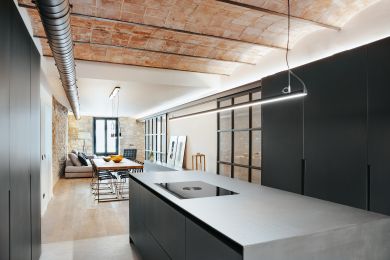
When discussing lighting, it is common to focus on power consumption, luminous flux or colour temperature. These are important characteristics, but they are far from telling the whole story.
In practice, the quality of lighting depends primarily on how light is controlled, distributed and perceived within a space. This is where three key elements of any luminaire come into play: the optical system, the diffuser and glare control.
Even when two luminaires use the same LED light source, the final result can be completely different. The difference lies not only in the amount of light emitted, but also in how that light is directed, distributed and integrated into the architecture.
Light is about more than quantity
It is easy to assume that two luminaires with the same power and luminous flux will produce exactly the same result. However, comparing them in a real project quickly shows that this is rarely the case.
One luminaire may provide precise, comfortable and uniform lighting, while another may create excessive brightness, unwanted shadows or waste light in areas where it is not needed.
The difference lies mainly in the engineering of the luminaire itself. Even when using the same LED technology, different optical systems, diffusers and construction solutions can produce completely different light distributions.
For this reason, evaluating a luminaire is about much more than looking at the number of lumens shown on the datasheet. The way light is controlled is often more important than the amount of light emitted.
In a lighting project, light does much more than simply make a space visible. It defines volumes, enhances materials, guides movement, creates atmosphere and has a direct impact on users' visual comfort.
Optics: controlling the direction of light
The optical system is responsible for controlling the direction and distribution of the light emitted by the source.
Depending on the luminaire, this function may be performed by reflectors, lenses or a combination of both. In technical lighting products, reflectors are often the main component responsible for shaping the light beam, while lenses provide even greater precision in controlling light distribution.
The optical system determines whether the beam is narrow or wide, concentrated or broad, symmetrical or asymmetrical, allowing the lighting to be adapted to the requirements of each application.
In practical terms, a well-designed optical system allows you to:
- Direct light exactly where it is needed.
- Reduce light losses in unnecessary areas.
- Improve the useful efficiency of the luminaire.
- Highlight specific architectural features.
- Enhance visual comfort.
This is particularly important in architectural lighting projects, where light should rarely be distributed uniformly without a clear purpose. Instead, it is often used to create visual hierarchy, emphasise materials, guide circulation or highlight specific areas within a space.
Not all optical systems are the same
When discussing optics, many people think only about beam angles. In reality, there are different optical technologies, each designed to meet specific lighting requirements.
Reflectors are among the most common solutions in technical lighting. They control light through reflection and, depending on their geometry and surface finish, can produce wide, narrow, asymmetrical or highly precise light distributions.
Lenses work differently. Rather than reflecting light, they use refraction to direct it, making them ideal for applications that require very precise beam control or the illumination of specific areas.
Many luminaires combine reflectors and lenses, taking advantage of both technologies to optimise luminous efficiency, light distribution and visual comfort.
The finish of the optical components also influences the final result. Mirror, matte, faceted or micro-structured surfaces all affect the way light is distributed and can help reduce glare, improve uniformity and enhance visual comfort.
This is why two luminaires that appear very similar can perform completely differently once installed in the same space.
The diffuser: softening the light
While the optical system controls the direction of light, the diffuser influences how that light is perceived.
Its main purpose is to soften the light output, blend the light more evenly and reduce the direct visibility of the LED source. Depending on the type of diffuser, it can also completely conceal the individual LED points, creating a continuous luminous surface that is more comfortable to look at.
This solution is particularly beneficial when a uniform, pleasant lighting effect is required, reducing excessive contrast between the luminaire and its surroundings.
However, there is always a trade-off. Depending on the material, thickness and finish of the diffuser, some luminous flux may be lost. In other words, visual comfort is improved, but maximum photometric efficiency is not always achieved.
In practice, diffusers are particularly suitable when:
- Uniform lighting is required.
- The light source is too visible.
- Reducing contrast between the light source and the surrounding environment is important.
- Visual comfort takes priority over maximum efficiency.
Glare: the factor that can compromise an entire lighting project
Glare is one of the most important, yet often underestimated, aspects of lighting.
It can occur when the light source is too visible, when the luminaire is incorrectly positioned or when its apparent luminance is too high in relation to the user's field of view.
The result is visual discomfort, eye fatigue and, in more demanding environments, reduced visual performance.
This is why glare control should be considered from the earliest stages of any lighting project. It is not enough to provide adequate light levels; the lighting must also remain comfortable throughout the use of the space.
In offices, schools, hospitals and many other indoor environments, parameters such as UGR (Unified Glare Rating) play a key role in lighting quality.
If you would like to learn more about this topic, read our article "UGR: What is it and why is it important?"
Light distribution matters more than you think
This is precisely why two luminaires with the same luminous flux can produce completely different results when installed in the same space.
The difference lies in how the light is distributed.
When evaluating a luminaire, looking only at the lumen output is not enough. The photometric distribution curve provides much more valuable information, showing how light is distributed in every direction and helping designers predict how the luminaire will perform in a project.
This information enables lighting designers to carry out simulations using software such as DIALux or Relux, allowing them to assess light distribution, illuminance levels, uniformity, glare and visual comfort before the luminaire is even installed.
Finding the right balance
There is no universal solution.
Selecting the right luminaire always involves balancing photometric performance, visual comfort, luminous efficiency and architectural intent.
In practice, factors such as the following should always be considered:
- The type of space and its intended use.
- The distance between the luminaire and the user.
- The required level of visual comfort.
- The importance of luminous efficiency.
- The architectural concept of the project.
For example, circulation areas often benefit from the homogeneous lighting provided by a diffuser, while feature lighting may require a more precise optical system to direct the beam accurately. In spaces where users have a direct view of the luminaire, glare control becomes even more important.
The best solution is almost always the one that achieves the right balance between all these factors according to the specific requirements of each project.
Conclusion
The quality of a lighting project depends not only on the amount of light available, but also on how that light is controlled.
The LED light source produces the light, but it is the luminaire that determines how that light reaches the space. The optical system controls its distribution, the diffuser influences visual perception and glare control ensures user comfort.
When these elements work together, lighting goes beyond its technical function. It enhances architecture, improves the user experience and creates spaces that are more comfortable, efficient and visually balanced.